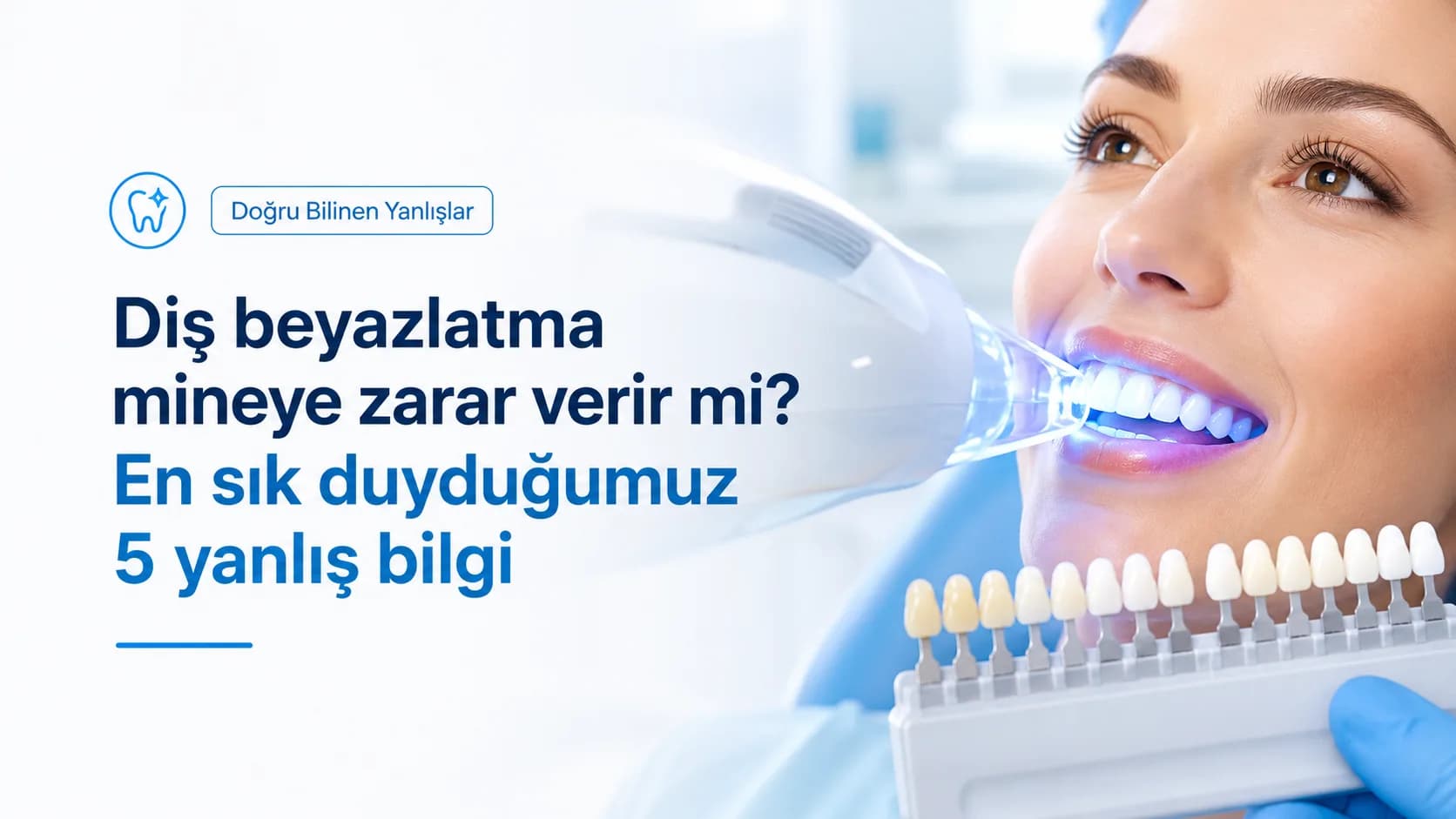
Does whitening thin your enamel? Five myths we hear most
The five claims about teeth whitening we hear most often from patients, weighed against what the evidence actually shows.
Contents
Few dental procedures attract as much misinformation as teeth whitening. Here are the five claims we hear most often in the clinic, and the reality behind each one.
Claim: "Whitening thins the enamel"
Not true. The active ingredient in whitening gels — hydrogen peroxide or carbamide peroxide — does not scrape or thin the enamel; it chemically breaks down the pigment molecules lodged within the enamel and dentine. The thickness of the tooth structure stays the same; only its colour lightens.
What actually causes wear is long-term use of abrasive "whitening" toothpastes. These lighten colour mechanically, by physically scouring the surface, not chemically — and shouldn't be confused with professional whitening.
Claim: "A supermarket product gives me the same result"
It doesn't. Over-the-counter products contain a lower concentration of active ingredient, and — just as important — nobody has assessed the state of your mouth beforehand. Gel that seeps over an open cavity can reach the nerve; unsupervised use can chemically burn the gum; generic, non-custom trays can overflow onto soft tissue and cause irritation.
In many patients, what looks like discolouration is actually calculus and surface build-up — after a professional clean, whitening may turn out to be unnecessary altogether.
Claim: "My fillings and crowns will whiten too"
They won't. Composite fillings, porcelain crowns and veneers are unaffected by whitening gel, because their structure differs from natural enamel. In patients with restorations in the visible front teeth, a colour mismatch can appear between the natural teeth and the restoration after whitening, sometimes making replacement necessary. Discussing this possibility beforehand avoids an unwelcome surprise.
Claim: "It works the same for everyone"
It doesn't. Results are generally good for staining from tea, coffee and smoking, and for age-related darkening. For tetracycline staining, fluorosis, and a single dark tooth after trauma, the effect may be limited or a different approach may be needed. Starting shade, dentine thickness and how translucent the enamel is all vary from person to person, so no one can promise a fixed number of shades in advance.
Claim: "Do it once and it stays forever"
It doesn't. Staining foods, drinks and the simple passage of time gradually bring the shade back toward its original tone. A touch-up every one to two years is often needed. Keeping your take-home trays turns that touch-up into a short, simple session.
In short: whitening is safe and its outcome predictable in people found suitable after a dental assessment. The decision starts with the overall health of the mouth, and only then considers the colour of the teeth.
The information on this page is for general guidance and does not replace a dental examination. Treatment decisions are made after an intraoral examination and radiographic assessment.
All articles